N.I.D. Agra India, Report Joan and Colin McKenzie
2005 PolioPlus National Immunisation Day, Agra, India
The Agra program started with a street-march along a main street with us distributing pamphlets advertising the National Immunisation Day. We were accompanied by about 15 auto rickshaws (‘puk puks’ with wheels the size a wheelbarrow and engines not much larger than a lawn mower) equipped with battery powered amplifier and large, old-fashioned speakers attached to the roof, like we used to see at carnivals when we were younger. At the end of the walk, we boarded the ‘puk puks’ (2 volunteers in each) with a raucous noise emitting from the loud speakers, and with great amusement for all concerned, we set off for a photo opportunity at a local hospital.
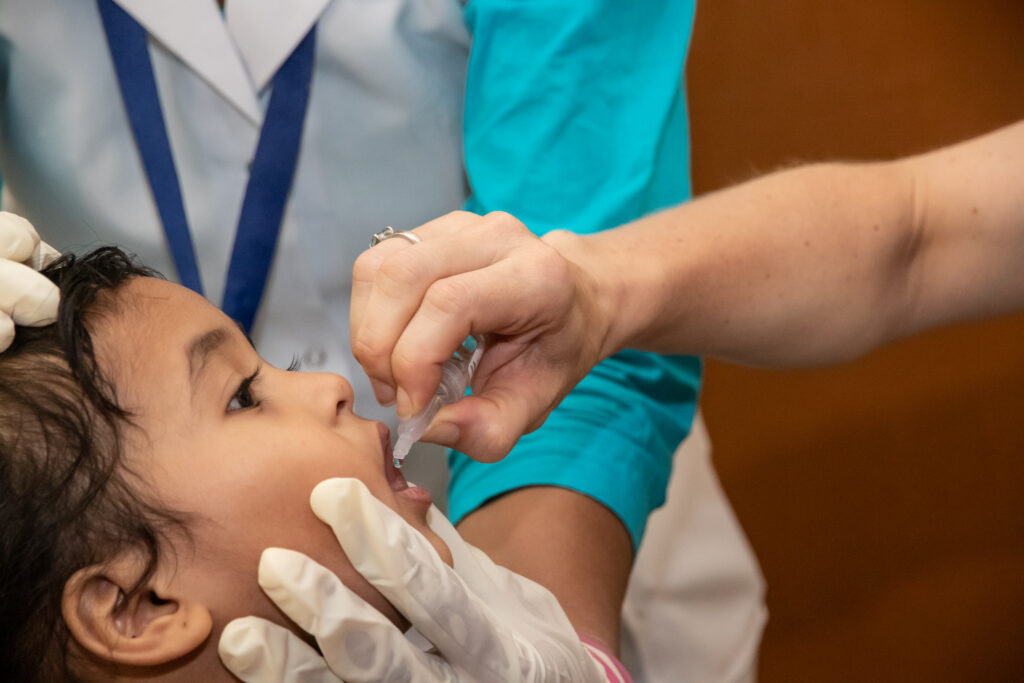
After photos were taken we paired off again and squeezed into a ‘puk puk’, trying not to dislodge the wires from the amplifier, and with our lives in our hands, went off through the narrow streets of the slums of Agra to what we would know as a community health centre. The walls of the centre were adorned with posters of previous PolioPlus campaigns. We found arrangements at the centre to be well organised and the staff very capable and caring. Most of the people who attended the centre came as family groups and were obviously very interested in the health and welfare of their children. We were able to take part in the polio eradication program by giving children under the age of five 2 drops of Sabin vaccine.
On arrival in Mumbai we saw many examples of advertising banners around the streets and were told that film stars had taken part in TV advertisements with the slogan: “Just 2 Drops”.
The Indian Government takes the campaign very seriously. Check points were set up at many public facilities. Children entering had their hands checked to see if their little finger had been marked with an indelible pen, indicating that they had already received the vaccine. Children who had not received the vaccine were directed to a booth and given the vaccine. It was also interesting to see health workers going door-to-door through the slum areas making sure that no child would be missed.
It would have been nice to think that we were the last PolioPlus Eradication Team to take part in an NID but the world can’t be declared free of polio until three years after the last case of polio is identified.
Reference: Colin and Joan McKenzie Rotary Club of Pascoe Vale Bulletin. 17 March 2005